
The BetterGrades student guide
Turn each lecture into a clear next step.
Use your notes, readings, and past exams to build focused practice. This guide shows you how to move from your first upload to a study routine that helps you find weak topics and decide what to do next.
Updated 16 September 2026 · Built from the BetterGrades iOS student journey.
Inside this guide
Build
A useful study set from one course source
Practise
Quizzes, flashcards, and Coach prompts
Focus
Weak topics and your next study action
Keep going
Routines, offline review, and optional challenges
Use it as a playbook
Follow the loop, then go deeper where you need it.
Start with the first four steps. After that, return to the section that matches your next study decision. You do not need to read the guide in one sitting.
Start here
Build your first useful study set
BetterGrades works best when each session follows the same loop: add the material your course uses, practise from it, review what you missed, then choose the next topic. Start with one course and one source so you can see the full loop without adding setup work.
01
Sign in without a password
Enter your email and use the six-digit code BetterGrades sends you. Keep the code private. You can return to the same study space on another session without creating a password.
02
Add one course source
Upload a lecture, reading, or past exam. Choose an existing course or create one, then wait for the source to finish processing.
03
Make a short practice set
Choose a quiz or flashcards. A five- or ten-question quiz gives you quick feedback, while a small flashcard deck gives you a repeatable recall session.
04
Use the feedback
Read the explanation and source reference for each answer. Use missed concepts to choose the next quiz, flashcard session, or Study Coach question.
Try this
A good first upload
Choose one lecture or a short reading rather than a whole semester of files. You will get clearer practice and a more useful first review.
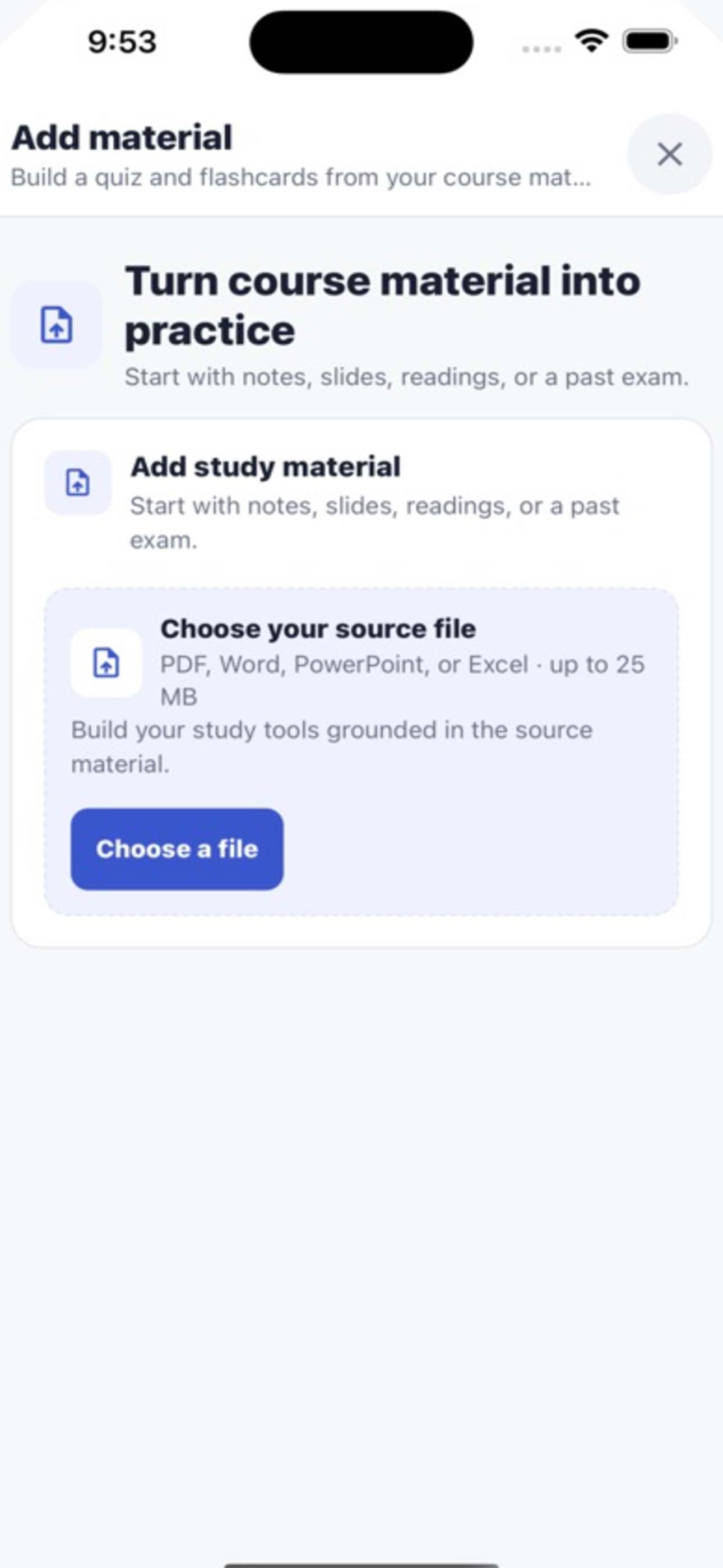
The first session starts with your own lectures, readings, or past exams.
1. Add your material
Give BetterGrades a source worth studying
Your files determine the context for every quiz, flashcard, and Coach answer. Add material that reflects what your course teaches and keep each upload connected to the right course.
01
Choose a supported file
BetterGrades accepts PDF, Word, PowerPoint, and Excel files up to 25 MB. On iPhone, you can also send a document from the Share Sheet or Open In menu.
02
Pick the course
Select the course that owns the material. If it does not exist yet, create it during the import flow and give it a name you will recognise during revision.
03
Wait for the source to become ready
BetterGrades extracts useful concepts and source context before it builds study tools. Keep the app online while you import and generate new activities.
04
Open the material before you trust a question
Use the source reference on a quiz, flashcard, or Coach answer to check the original wording. This habit helps you catch a misleading summary or an AI mistake early.
- Use lecture notes to test the concepts your lecturer introduced.
- Use readings to practise definitions, arguments, and examples.
- Use a past exam to rehearse the style and topics you expect to see.
- Give similar material clear filenames so you can choose the right source later.
Check this
If processing fails
Check the file type and size, then try again. Password-protected, corrupt, or unreadable files may need a clean export before BetterGrades can use them.
Keep in mind
Your consent matters
BetterGrades asks for permission before it sends course material to OpenAI for requested study tools and Coach answers. Review the AI processing setting in Settings whenever you need to.
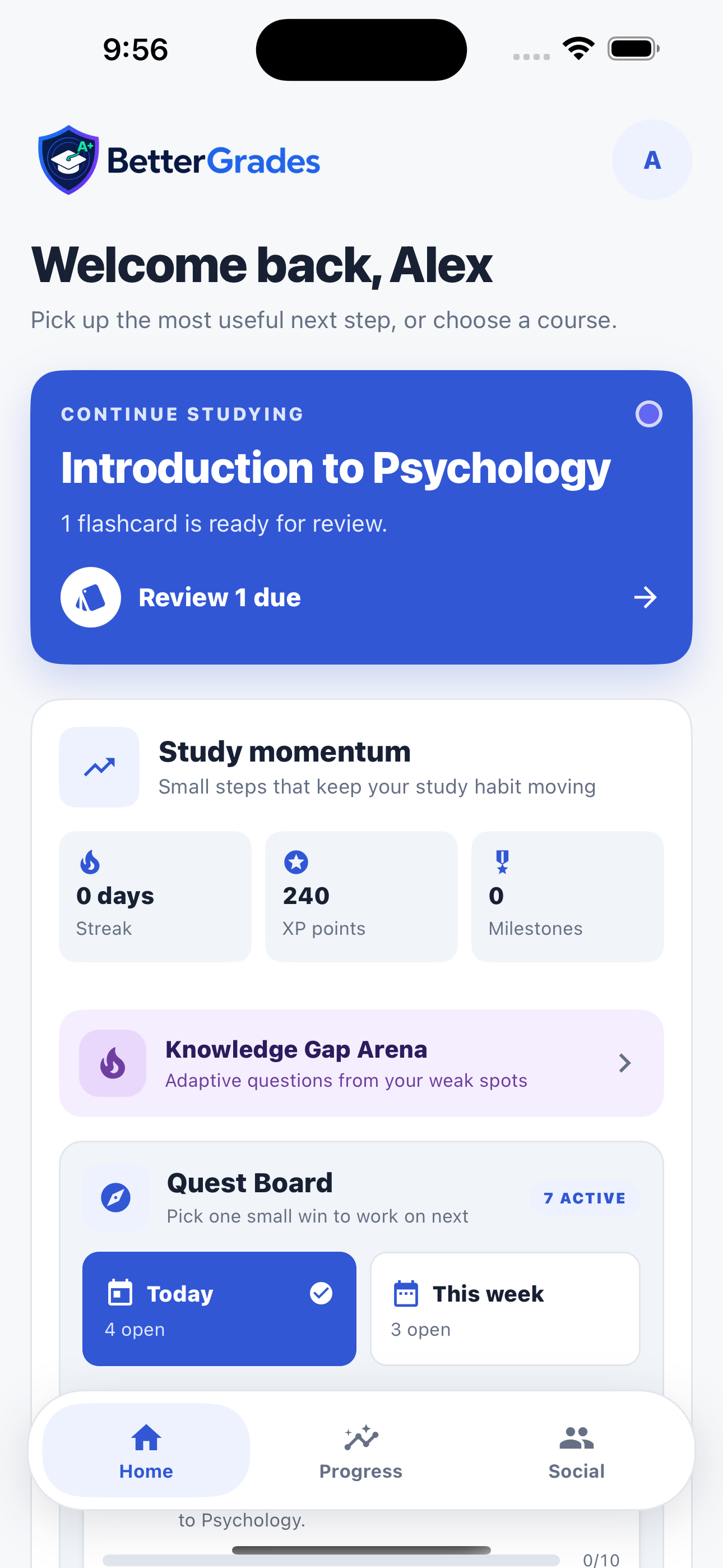
The course card keeps your source material and practice actions together.
2. Make better quizzes
Choose settings that match the way you need to think
Quiz Lab lets you choose the source, length, difficulty, question types, and marking focus. Use those choices to change the job of the quiz instead of generating the same kind of practice every time.
01
Select Quiz in Quiz Lab
Open a course, choose Quizzes, and create a new quiz. Select one or more ready course documents as the source.
02
Set a useful length
Choose five questions for a quick check, ten for a normal revision block, or twenty when you have time to cover more of the source.
03
Match difficulty to your goal
Easy focuses on recall. Medium asks you to apply an idea. Hard gives you a stronger challenge. Start at Medium when you want a balanced check, then move up when the basics feel familiar.
04
Choose the kind of thinking
Use multiple choice and true or false for fast retrieval. In Advanced options, choose a marking focus such as definitions, reasoning, steps, or application when the source supports it.
05
Generate while online
BetterGrades reviews the source, balances the practice, and finalises the question set. Keep your connection active until the quiz is ready.
Try this
A reliable quiz pattern
Use five or ten Medium questions after a lecture. Review every miss, wait a day, then try a focused quiz on the concepts you still hesitate over.
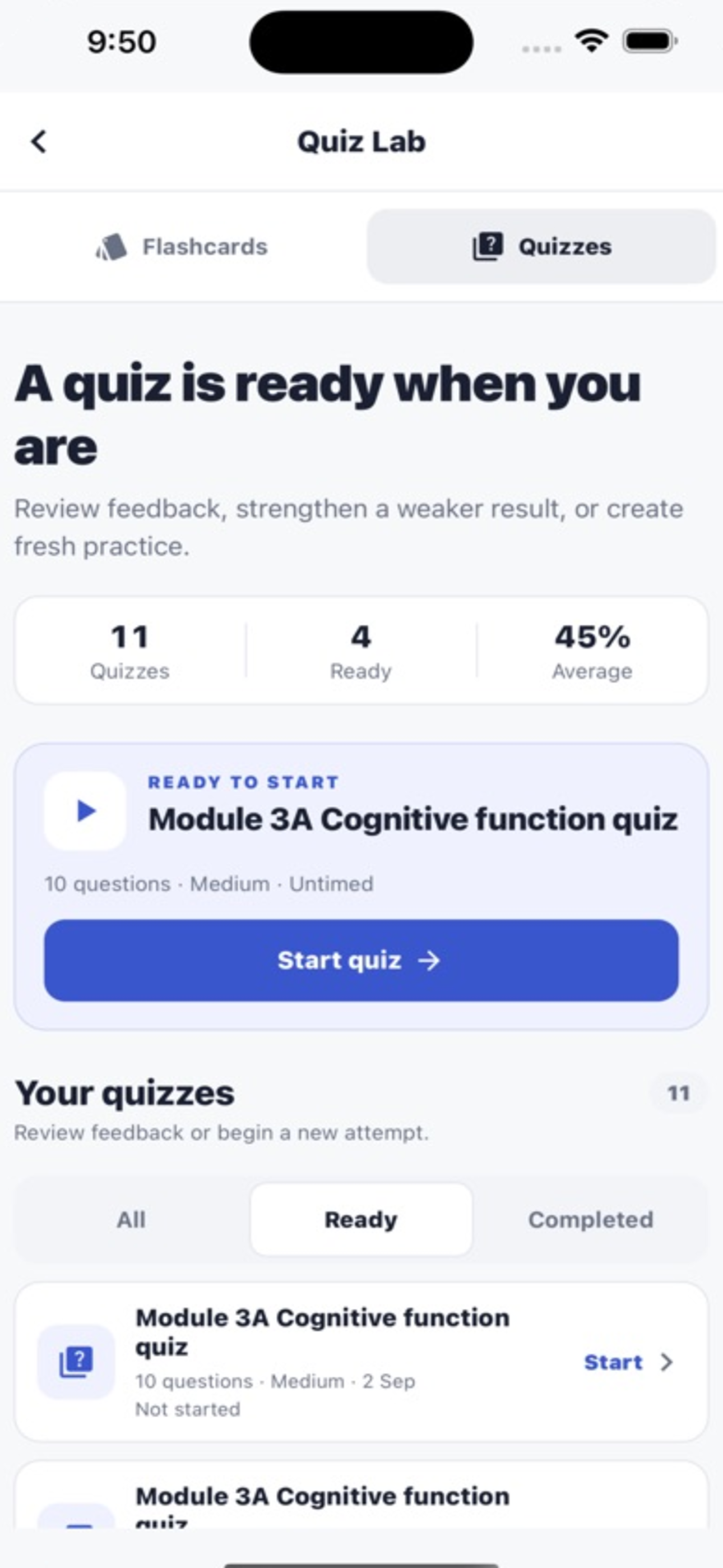
Quiz Lab gives you a clear practice choice before you start answering.
3. Learn from quiz feedback
Treat every missed answer as a study instruction
A quiz score describes one attempt. The useful part comes after you submit: BetterGrades shows missed answers, explanations, topic performance, and the source context behind the result.
01
Finish the set before checking the answer
Commit to an answer, even when you feel unsure. Retrieval gives you a clearer signal than rereading the prompt until it feels familiar.
02
Open Review missed answers
Read the correct answer and explanation for each miss. Notice whether you forgot a definition, confused two ideas, or applied a process in the wrong order.
03
Follow the source reference
Use the cited document and page or source context to compare the explanation with your material. Keep a short note in your own words if the concept still feels unclear.
04
Choose the next action
Retake the quiz later, review related flashcards, open the weak-topic analysis, or ask Study Coach to explain the concept from your course material.
Keep in mind
Use scores with context
A score helps you compare your practice over time. It does not predict an official course grade or prove that you have covered an entire exam.
4. Review flashcards
Turn recognition into recall
Flashcards work when you answer before you reveal. BetterGrades uses your rating to schedule the next review, so an honest response creates a more useful queue than a generous one.
01
Generate a deck from a ready source
Choose Flashcards in the study builder, select the course material, and choose ten, twenty, or thirty cards. Generate new decks while online.
02
Say the answer before you tap
Read the front, pause, and answer in your head or out loud. Tap Reveal flashcard answer only after you commit.
03
Rate the effort, not the feeling
Choose Again if you forgot, Hard if you remembered with effort, Good if you remembered, or Easy if the answer came instantly.
04
Return when cards become due
The review queue separates New, Learning, Familiar, and Mastered cards. Use the due count on Home or the Flashcards screen to keep the queue moving.
Try this
Make the card do one job
If a card asks for a long list or a whole lecture, split the idea into smaller prompts in your own notes or edit the card in Your deck.
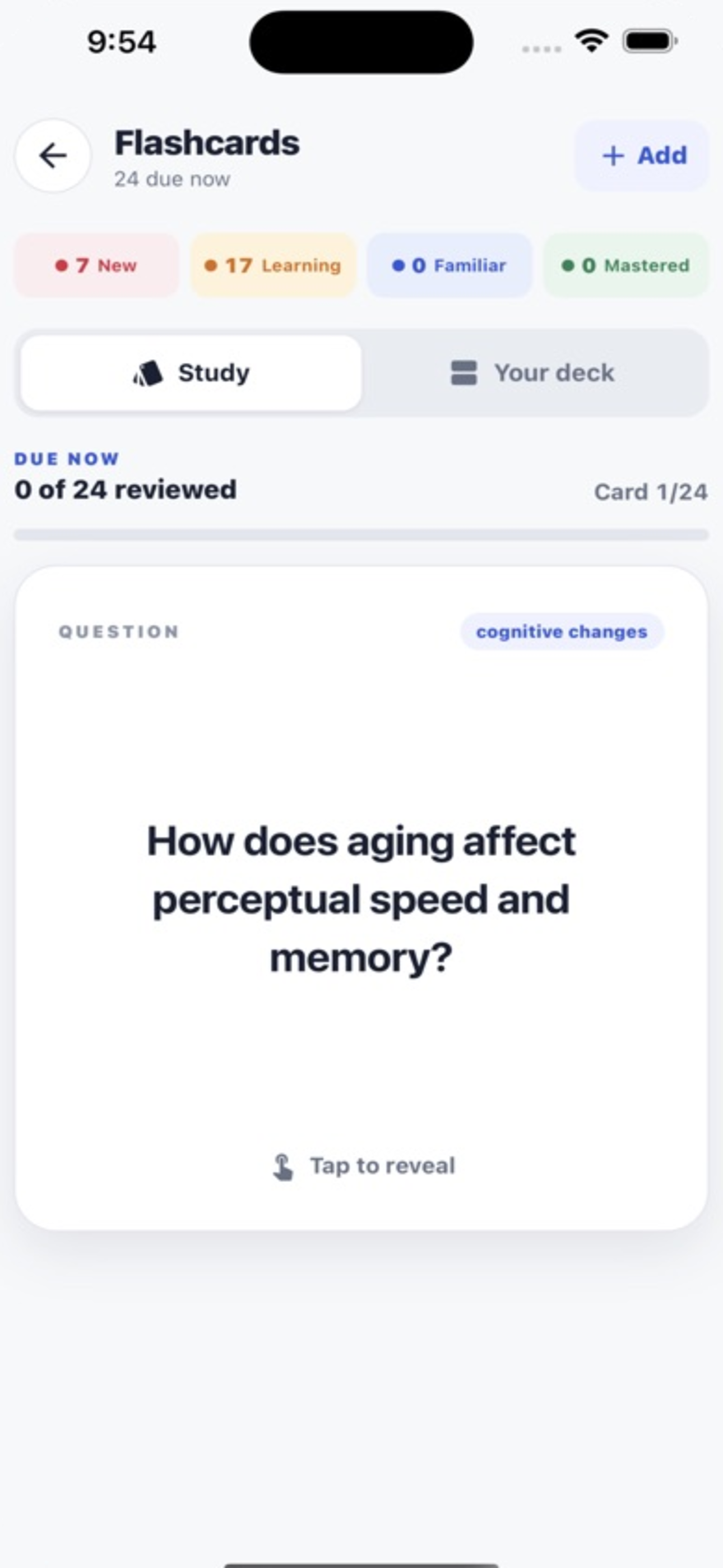
Reveal only after you have tried to retrieve the answer.
5. Find your next topic
Let your weak topics shape the next session
You do not need to guess what to revise next. Home, Exam Readiness, and the course analysis connect your practice history to a concrete next action.
01
Start with the course card on Home
Look for the course summary and the prompt that says concepts need attention. Open the analysis to see where your current practice has gaps.
02
Read Exam Readiness as a map
Review the readiness status, practised concept coverage, topic scores, and recommended action. Use the view to decide where to spend your next block.
03
Open the weakest concept
Weak Topics shows mastery, attempts, importance, and the recommended next step. Sort by Gap when you want the concept that needs the most attention first.
04
Generate focused practice
Create a quiz or flashcards for the concepts that need attention. Focus Pass can build a short quiz from your weakest available topic when you want a guided option.
Try this
Use a small gap to start
Pick one weak concept, practise it, and check the source. A focused session gives you a cleaner signal than opening every topic at once.
Check this
Readiness is study guidance
Exam Readiness helps you choose practice. It is not an official grade, a prediction, or proof of complete exam coverage.
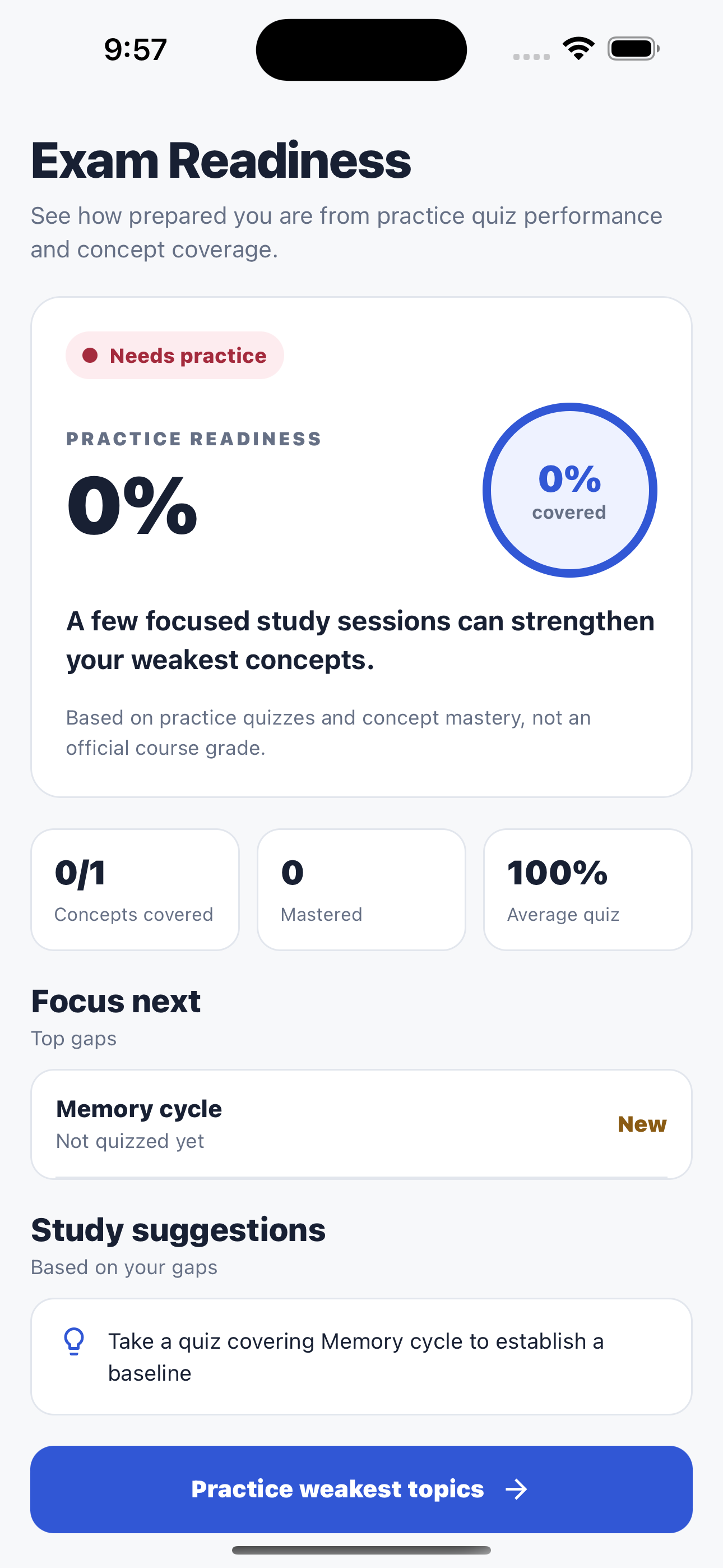
Exam Readiness turns recent practice into a next-topic decision.
6. Ask Study Coach
Use Coach to explain, question, and plan
Study Coach answers within a course context and shows references under Referenced in your guide. Ask for one clear job at a time so the answer helps you practise rather than replace your thinking.
01
Ask about the course you are studying
Open Study Coach from the course and keep your question tied to the material you uploaded.
02
Give the answer a job
Ask Coach to explain a distinction, quiz you without showing the answer, compare two concepts, or suggest the next review action.
03
Use prompts that create practice
Try: Explain encoding versus storage in two sentences. Quiz me on the working memory model one question at a time. What should I review before I retake my quiz?
04
Check the reference before you rely on it
Open the cited source context and compare important definitions, formulas, dates, and processes with your original material or lecturer guidance.
Check this
Coach can make mistakes
Treat an answer as a study aid. Check important information against your source material and ask your lecturer or tutor when the source and answer disagree.
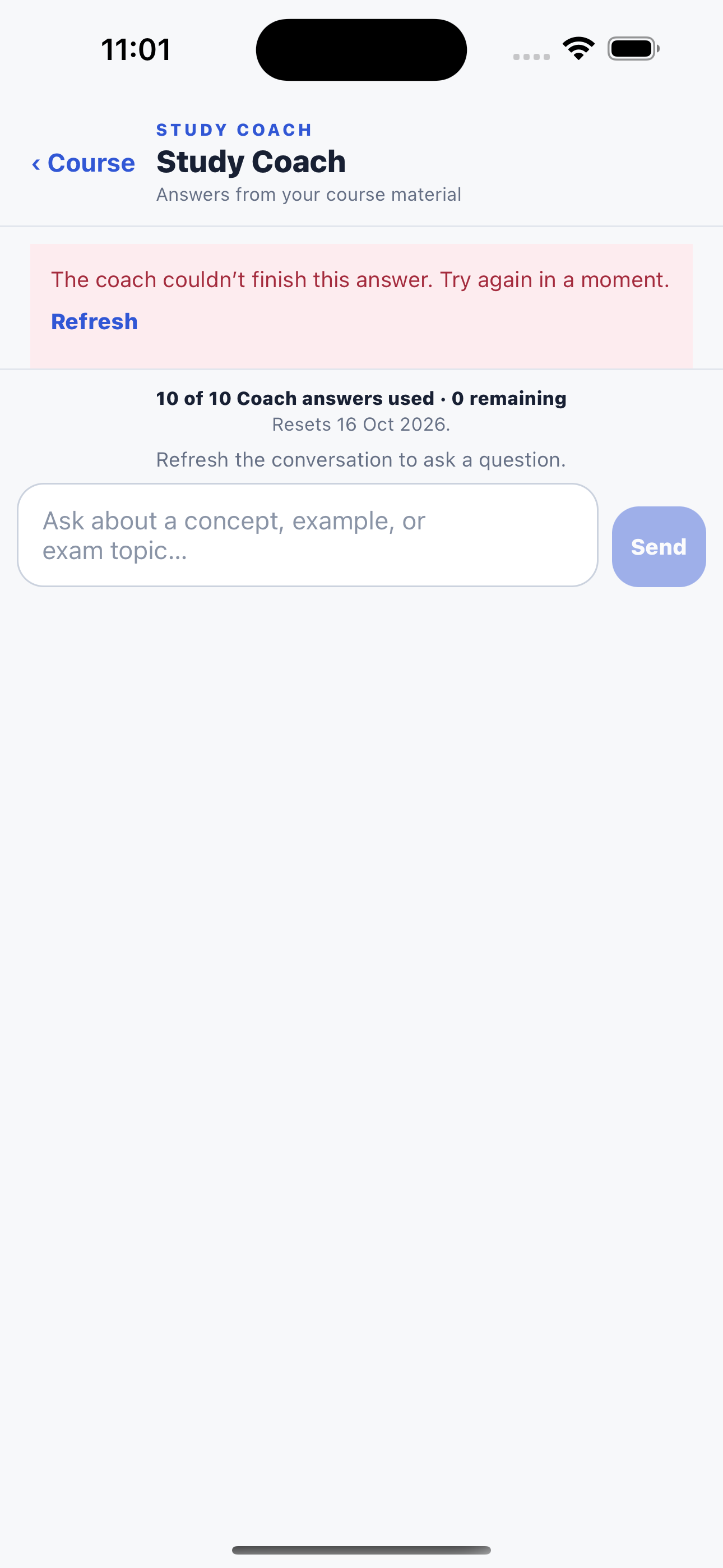
Coach shows its usage counter and a clear retry path when an answer cannot finish.
7. Build a repeatable routine
Use the app around your course week
The best study plan is one you can repeat between lectures, work, and other commitments. Use short sessions to keep concepts active, then use targeted practice when a topic needs more time.
01
After each lecture
Upload the lecture or reading to the right course. Create a five- or ten-question quiz while the ideas are still fresh.
02
On the next study day
Review due flashcards first. Do not reveal the answer until you have tried to recall it, then rate the effort honestly.
03
When a quiz exposes a gap
Read the explanation and source, then create a focused quiz or card set for the weak concept. Study the smallest useful unit before moving on.
04
Before the exam
Use Exam Readiness and Weak Topics to choose a final review order. Mix recall, application, and source checking instead of rereading every file from the beginning.
- A 20-minute session: five minutes of due cards, ten minutes of quiz practice, five minutes of reviewing misses.
- A longer session: repeat the loop with a second weak concept or a harder quiz.
- A weekly check-in: review Progress, then choose one course that needs attention next.
- Set a study reminder in Settings when a regular time helps you protect the habit.
Keep in mind
Rewards are feedback for your routine
Streaks, XP, quests, and milestones encourage activity. They do not measure your intelligence or academic ability. Choose the task that improves your understanding.
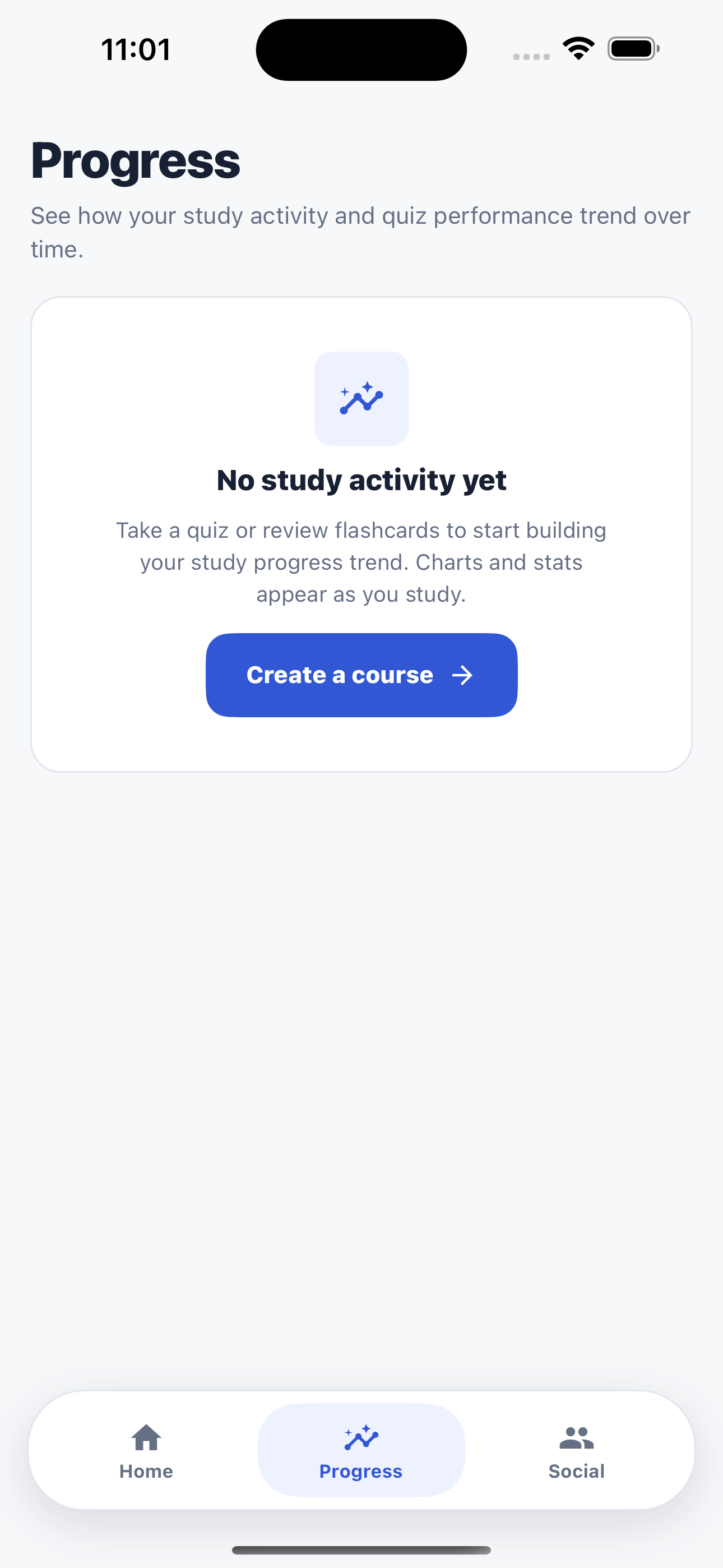
Progress starts with a simple next action, then fills with trends and stats as you study.
8. Use progress and rewards well
Let momentum support the work
BetterGrades records the activity that helps you keep studying. Use those signals to plan your week, not to turn revision into a points chase.
- Open Progress to see study sessions, average quiz score, flashcard reviews, activity trends, and course breakdowns.
- Use the Quest Board to turn a large plan into a small action such as reviewing ten cards or completing a course quiz.
- Use Focus Pass when you want a short quiz built from a weak topic rather than another broad review.
- Try Knowledge Gap Arena when you want fast adaptive questions from weak spots and immediate feedback.
- Use Study Wrapped or sharing only when the summary helps you reflect on your routine.
Try this
Choose a useful reward target
Pair a quest with a study action. For example, complete Card Sprint by reviewing cards you actually find difficult, not by tapping through familiar answers.
9. Go further
Use the optional tools when they fit your week
The core loop carries most of your study. These tools add variety when you want a challenge, need to study without a connection, or want friends to help you stay accountable.
01
Review offline
Flashcards and quizzes saved on your device remain available for review when you are offline. New study generation needs a connection, and progress can sync after you reconnect.
02
Try Knowledge Gap Arena
Enter a wave of adaptive questions from your weak spots. Use the feedback after each run to decide whether you need cards, a focused quiz, or a source review.
03
Battle a concept
Concept bounties and boss battles give one developing concept a focused challenge. Treat the result as another signal about what to practise next.
04
Challenge a friend
Social supports friend challenges, ghost or best-score targets, weekly progress, and referrals. Join when friendly accountability helps you show up.
Keep in mind
Keep social optional
Accepted friends can see only the study signals you choose to share. Your course material, answers, and private content stay private.
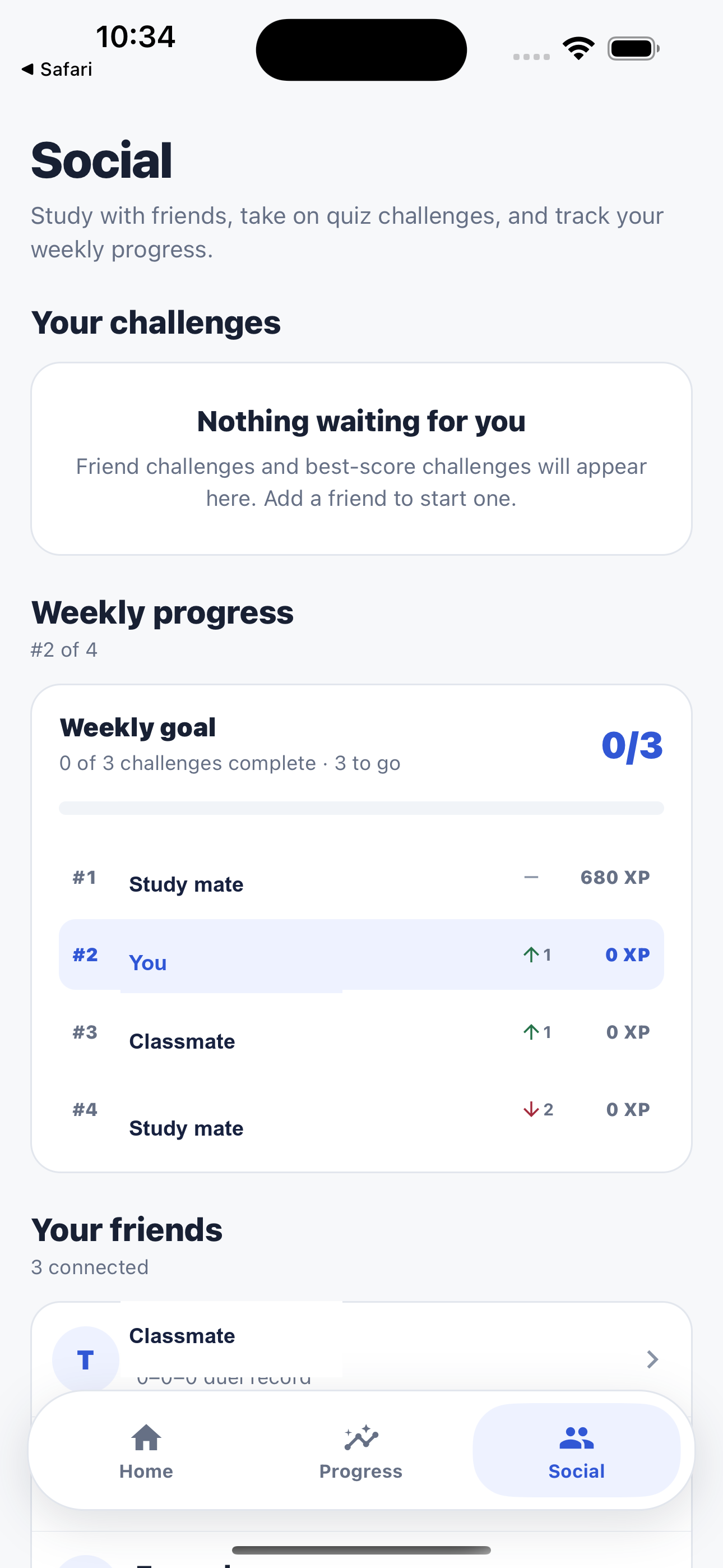
Social tools add accountability without exposing your course material.
10. Manage your study space
Choose what the app stores, shares, and reminds you about
Settings lets you shape BetterGrades around your schedule and privacy preferences. Review these controls when your routine changes or when you start studying with classmates.
- Study reminders: choose a daily reminder time or turn reminders off.
- Offline storage: see what the device saved for review and clear a course download when you need space. Clearing offline data does not remove your online course or progress.
- Friend updates: control alerts for invitations and accepted requests.
- Share study activity: decide whether accepted friends can see your current streak and whether you studied today.
- Best-score challenges: decide whether friends can use your saved score as a challenge target.
- AI processing: review whether BetterGrades can send course material and Coach questions to OpenAI for requested tools and answers.
- Premium and account actions: manage a subscription, restore purchases, sign out, or request account deletion from Settings.
Try this
Review before sharing
Turn on only the social signals that make your study better. You can change these settings later without sharing course content.
11. Limits and recovery
Know what to expect when a limit or error appears
Clear limits help you plan your study builds. When something fails, the app keeps the recovery path close to the message so you can fix the source, reconnect, or choose a smaller request.
- Free access includes five study builds. A study build creates a quiz or flashcard deck. The app shows your remaining builds and reset date.
- Free access includes ten Study Coach answers each month. Check the counter in Coach when you plan a longer question session.
- Premium currently offers Monthly at $4.99 USD per month or Annual at $49.99 USD per year, equivalent to two free months. Subscriptions renew automatically until cancelled.
- Saved study tools stay available if you cancel. Premium continues through the current paid period, subject to the app store safeguards.
- If a source cannot support the requested number of questions, add more material or request fewer questions.
- If generation stops, reconnect and retry. Offline review still works for saved quizzes and flashcards.
- If an answer looks wrong, open its source reference and compare it with your material before studying from it.
Check this
Pricing and limits can change
The app shows the current entitlement, reset date, and store price at the time you use it. Check the in-app paywall and Settings before making a billing decision.
Keep in mind
Need help?
Contact support@bettergrades.app with the course, screen, and action that failed. Do not include your sign-in code or sensitive course material in the message.
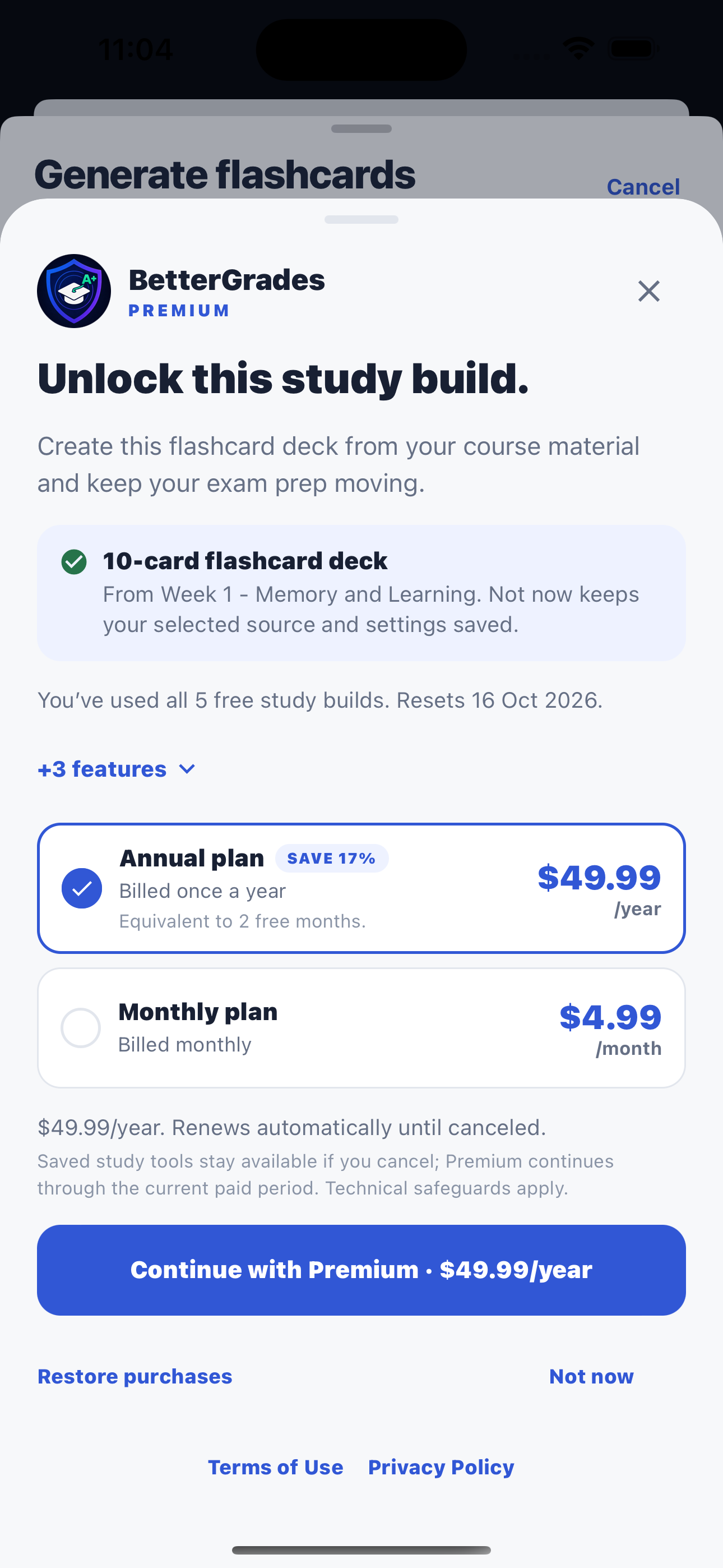
If you reach the limit, the offer keeps your selected source and settings saved while showing the current plans.
Quick reference
Your next six study moves.
Save this list for the start of a session. It keeps the app focused on the work that helps you understand the material.
01
Add one ready course source, then check the source reference before you trust a question.
02
Use a five- or ten-question Medium quiz after a lecture to get a fast signal.
03
Review missed answers before you generate another broad quiz.
04
Answer flashcards before you reveal them, then rate your recall honestly.
05
Use Weak Topics or Exam Readiness to choose one concept for your next session.
06
Check important AI answers against your original material.
Quick answers
Questions students ask before they start.
What should I upload first?
Start with one lecture, reading, or past exam from the course you want to study. A focused source helps BetterGrades create clearer practice and gives you a simple first session.
Which file types can I use?
BetterGrades accepts PDF, Word, PowerPoint, and Excel files up to 25 MB. iPhone also supports document handoff through the Share Sheet or Open In menu.
How do source references help?
Questions, flashcards, and Study Coach answers can point back to the course material used to create them. Open the reference when you want to check a definition, explanation, or process against the original source.
Can BetterGrades replace my lecture or textbook?
No. BetterGrades turns your material into practice and helps you choose a next topic. Keep using your lecturer guidance, readings, and original sources as the authority for your course.
Can I study without internet?
You can review saved flashcards and quizzes offline. New uploads and study generation need a connection. Progress can sync after you reconnect.
What happens when I reach the Free limit?
The app shows your study-build or Coach-answer usage and the reset date. You can wait for the reset, request a smaller study activity when the source supports it, or review the Premium options shown in the app.
Is my course material visible to friends?
No. Social settings control study signals such as your streak or whether you studied today. Your course material, answers, and private content remain private.
What should I do if an AI answer looks wrong?
Open the source reference and compare the answer with the original material. Check important information with your lecturer or tutor when the source and answer disagree.
Keep your next session simple
Start with one course source.
Add a lecture, reading, or past exam, then let your practice show you what to do next.
Start with a lecture, reading, or past exam.